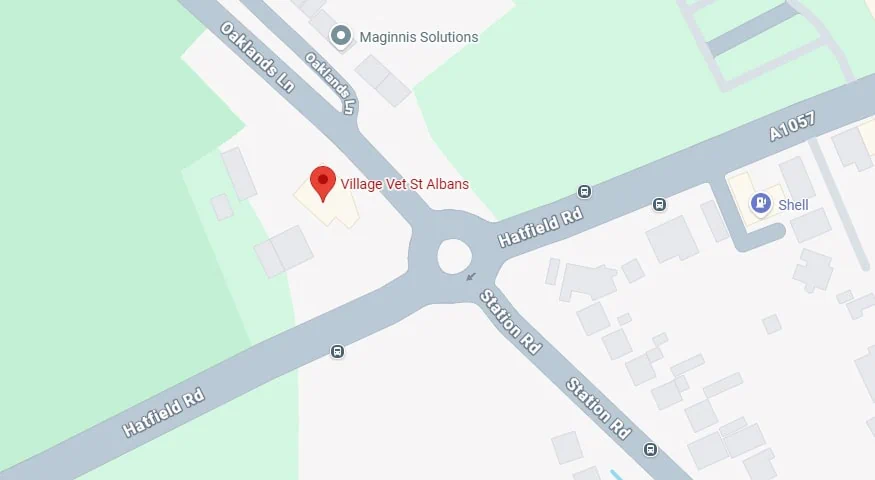
Village Vet St Albans
Free parking on site, directly outside the hospital.
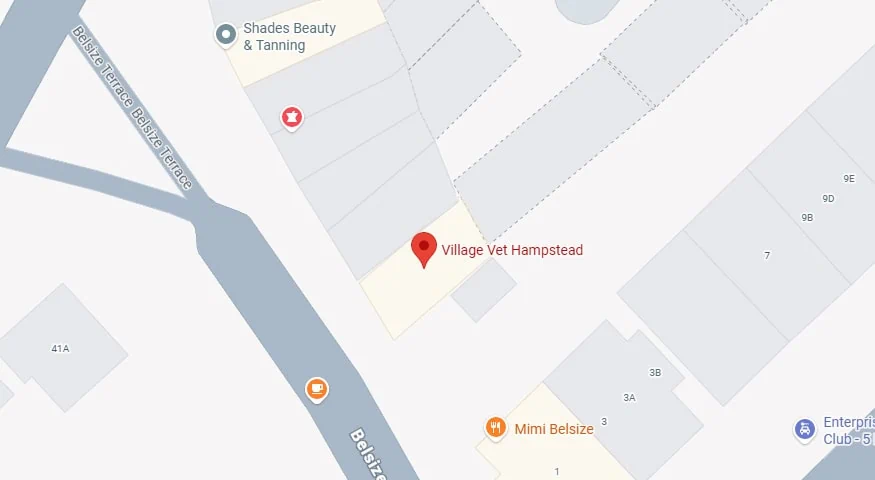
Village Vet Hampstead
Street parking nearby; details on the practice page.
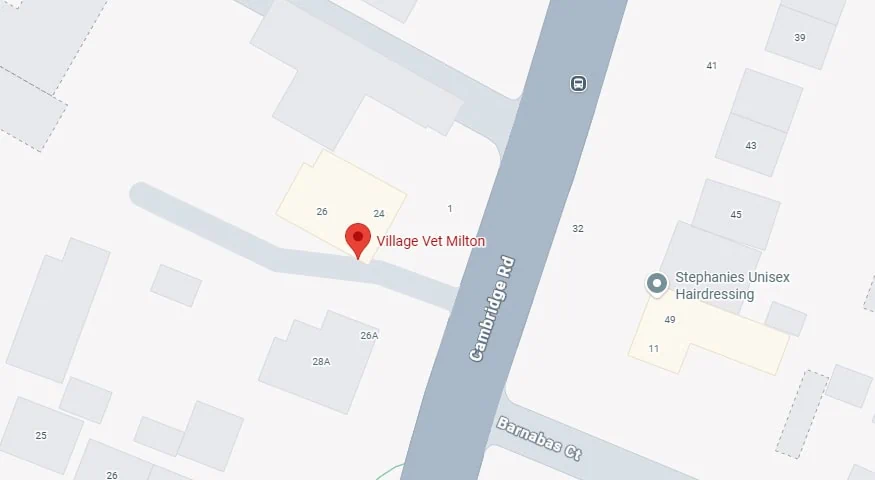
Village Vet Milton
Free parking on site.
Is it an emergency?
What to do
- Keep calm. Your pet needs your support.
- Call the nearest hospital above for advice and to tell us you are on your way.
- Travel safely. Keep cats in a carrier and dogs restrained.
Call us now if your pet has any of these
- Difficulty breathing, collapse or fitting
- Suspected poisoning
- A road traffic accident or serious injury
- A bloated or swollen abdomen
- Difficulty giving birth
- Not sure? Call anyway. We would rather you rang.
What happens at an emergency appointment
Our emergency facilities
Anaesthesia
The surgical nurses are highly trained in modern anaesthetic monitoring techniques, and all patients under anaesthesia are also monitored with equipment similar to that used in human theatres.
Many patients coming to our 24-hour clinics and hospitals are critically ill or injured. This means that it is even more important to do everything possible to ensure anaesthetic safety. To achieve this, pets are blood-tested prior to surgery to check health of kidneys, liver and other organs and infusions (intravenous drips) are set up to maintain blood pressure.
We only use the best anaesthetic agents available for pets. A qualified vet nurse monitors the patient closely throughout the anaesthesia including: pulse rate, oxygen concentration in the blood, breathing rate and body temperature. Pain relief, even for the smallest procedure, is paramount. Our nurses are also there to provide love and care as your pet wakes up.
ICU
The Intensive Care Unit (ICU) is the heart of each of our hospitals and 24-hour clinics. Here, you find the wards, examination areas, monitoring equipment, oxygen kennels and infusion pumps all in close proximity.
Infusion pumps allow constant rates of replacement fluids to be given to patients, monitoring equipment alerts our vets and nurses to patients showing signs of deterioration and oxygen kennels allow patients with severe cardio-vascular problems to breathe pure oxygen.
By having all this close to hand, your pet can be monitored continuously and any emergencies dealt with promptly.
In-House Laboratory
Our centres are both equipped with in-house laboratories. This means that blood, urine and other samples taken from your pet can be analysed quickly rather than having to await the results from samples sent out to external laboratories.
In critical cases, getting to the bottom of your pet’s problem quickly can sometimes be the difference between life and death.
Surgery
If your pet should require an operation, you should rest assured that the calibre of our surgical resources is second to none.
Our promise to set the highest of standards is delivered through the calibre of our vets and nurses. This, along with the advanced nature of our theatre equipment and facilities, plus our choice of the most modern anaesthetics, means that your pet couldn’t be in better hands.
Our surgical equipment is of the highest quality, much of it similar to that used in human hospitals, and spans all procedures from delicate eye surgery to fracture repair to surgical treatment of the spine. We have dedicated, sterile state-of-the-art operating theatres, tables and lighting so that surgery can be performed by our vets in the best possible conditions.
Ultrasound
Ultrasound is an imaging technique in which deep structures of the body can be visualised by recording echoes of ultrasonic waves directed into the tissues.
Because you get a moving image with ultrasound you can see precisely how the body is functioning in a safe and non-invasive way. In particular we can check the size, structure and appearance of internal organs to see how each one is working in action. With the heart, we can use ultrasound to watch it beating, look at its size and see if the valves are functioning correctly.
With the intestines, we can assess if muscles are contracting properly as part of the body’s mechanisms for processing food. Ultrasound is ideal for getting a close look at small organs (kidneys, liver and spleen) and to check for foreign structures in the chest. Images can be frozen and then printed from the computer to provide a positive record of the examination.
Ultrasound may be used in conjunction with X-ray to give a full picture of what might be wrong – some problems are more apparent with ultrasound than X-ray and vice versa.
X-Ray
At our hospitals and 24-hour clinics, X-rays are taken, read and interpreted to help ‘look inside’ your pet and diagnose problems quickly. Where required, within our group, we have veterinarians with advanced post-graduate qualifications in this field to help interpret unusual findings.
Veterinary Medicine is moving at tremendous pace – we always aims to be at the forefront by offering your pet the best facilities and care available. Our latest development is the introduction of digital X-ray equipment at both our centres.
Much like digital photography, digital radiography removes the need for processing of films and means that X-ray images are instantly available for examination by our vets and visible on all computer screens within the centre. We can also easily e-mail the X-ray images to your primary care practice for discussion with your primary care vet and for storage with your pet’s records.
Please let us know if you would like to view your pet’s X-rays.